



2 April, 2015
Our goal is to provide the best training to our government leaders
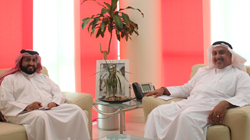
The Institute of Public Administration in the Kingdom of Bahrain (BIPA), which was established by royal decree in June 2006 in order to develop public administration and training in ministries and state institutions and to contribute to the preparation and training of employees to be the ideal partner for developing civil service employees with excellence, and to provide its value-added services to the public sector within the framework of qualitative quality assurance. Al-Bayan met with the Director-General of the Institute, Dr. Raed Mohammed bin Shams, who revealed that the Institute seeks to cover the main needs of the government sector in terms of leadership programs, specialized and basic programs, in addition to courses. Short courses that contribute to raising personal capabilities at all career levels, in addition to consulting, research and evaluation services.
Data issued by the Institute of Public Administration (BIPA) showed that it had completed the training of 35.5% of government employees, amounting to 17,812 trainees over 6 years. 16,578 trainees benefited from basic programs, 890 from professionalism, and 344 from leadership, until the institute became one of the expertise houses accredited by well-established international institutions in the field of public administration. The data revealed that the contractual courses resulted in the training of 4,332 government employees.
Dr. Bin Shams confirmed that the Institute of Public Administration (BIPA) is making every effort to provide the best quality training programs that directly prepare and develop government leaders and achieve one of the strategic priorities within the work program of the Government of the Kingdom of Bahrain, which is “An effective and efficient government in order to serve citizens.” With regard to the institute’s role in supporting Bahraini women to advance them and prepare women leaders capable of assuming responsibility, he explained that the majority of graduates of the program for preparing new government leaders (cadres) - which prepares heads of departments in the government - are women, at a rate of up to 56%.
Dr. Bin Shams revealed the master's program in public administration, which is considered the first of its kind and will be a central station for developing knowledge in the Arab world region, which came in partnership with the National School of Administration (ENA) and the French University of Aix-Marcy, which is considered one of the best 150 universities in the world. He pointed out that there is a great demand from the GCC countries to study this program.
The Director General of the Institute of Public Administration also explained that there is a conference that will be held in Tunisia next October, which is the Middle East and North Africa Network for Public Administration Research Conference (MENAPAR), in which many specialists in the field of public administration will gather to develop scientific research in the region. He explained that this conference is a Bahraini initiative. The text of the dialogue is as follows:
** You announced a plan for the institute’s training programs for the current year. What is the most prominent content of this plan?
The training plan of the Institute of Public Administration is divided into training programs that cover the main needs of the government sector, including leadership programs, specialized programs, and basic programs, in addition to short courses that contribute to raising Personal capabilities for all job levels. The Institute also offers electronic courses that keep pace with the modern technical era. Finally, the Institute has its own list of contractual courses that are held based on special training needs as requested by the ministry submitting the application.
We began our training programs in 2009, and the general framework for the programs was established, whether basic, specialized, or leadership, such as the (Kawader) program, which qualifies department heads to be managers, the (Leadership) program, which prepares managers to be assistant agents, service, and excellence, or specialized programs such as the professional certificate program in the foundations of human resources, the basics of government project management program, the excellence program in government services management (Tamayoz), the customer service program in the government sector (service), or basic programs such as the sector preparation program. General (Taheb) and electronic courses, and there are new programs that will be launched during this year, the most important of which is the (Takween) program. According to the agreement with the Civil Service Council and the Coordination Committee chaired by His Royal Highness Prince Salman bin Hamad Al Khalifa, the Crown Prince, Deputy Supreme Commander and First Deputy Prime Minister, and within the framework of His Highness’s keenness to enhance the expertise of national cadres working in the government sector, a group of programs will be presented related to administrative qualification for higher levels, which are aimed at preparing for employment. Higher-level jobs or adding new administrative expertise to these levels.
We now have a vacancy for the lower level of cadres, that is, less than department heads (senior specialists) who have the potential to take on the leadership administrative role, that is, thinking and dealing with others. It will be somewhat different because there will be employees responsible for them, and therefore the idea of the (Takween) program is to be the beginning of the path to leadership programs.
** The Institute launched the National Program for Preparing Government Leadership. Can you explain to us the objectives of this program?
Government work requires leaders at various levels. For example, in the (Tahheeh) program - directed to newcomers to government work - we discovered leadership energies who presented new projects for which they received awards. Also in the (Tamayoz) program, some participants presented programs of change on the ground to serve the citizen, which is heartening. In the (Kawader) program - directed to department heads - 5 new government policies were presented in housing and in the municipality to change reality for the better, and therefore there are actually leaders at all levels. The program The goal of the National Government Leadership Preparation Center is not only to develop senior leaders, but rather all leaders at all levels. Leadership is not only the person of the leader, but is interconnected with whoever adopts the thought of this leader, and this leader must create new leaders by developing them, understanding them, and meeting them. Their functional or even life needs.
The objectives of the National Program for Preparing and Developing Government Leaderships are directly aimed at achieving one of the strategic priorities within the work program of the Government of the Kingdom of Bahrain, which is “an effective and efficient government in order to serve citizens,” which demonstrates the extent to which the strategic plan of the program is interconnected and consistent with the strategic plan of the government. The objectives include preparing second-level leaders, creating new cadres, and retaining competent national cadres for the continuity of government work and creating excellence in it, in addition to defining clear career paths for government leaders, which contributes to organizing the appointment process in government positions.
** How does the institute support Bahraini women to advance them and prepare women leaders capable of assuming responsibility?
The Institute of Public Administration works to empower Bahraini women and raise their contributions to the development process, through effective and direct coordination with the Supreme Council for Women in order to implement the National Plan for the Advancement of Bahraini Women 2013-2022 AD, in addition to intensifying programs aimed at empowering women to obtain equal opportunities in all areas of life, and strengthening their status for their advancement. The Institute offers special training courses for women, such as the Women’s Leadership Course. For example, the “Cadres” program, from which the majority of graduates are women. 56%, in addition to other programs with the Supreme Council for Women to raise awareness of the most important issues in society in general existing needs, and we also have short courses that focus on the relationship between home and work and how working women can reconcile their responsibilities as a mother and an employee.
** The Master of Public Administration program was recently announced. How far has the project reached?
After conducting a survey feasibility study, the idea came about the importance of having a Master of Public Administration program and its continuity as a central attraction for knowledge development in the Arab world region, as this professional program is considered the first of its kind in the Kingdom of Bahrain, which was designed after a number of field visits in the Gulf region to learn about best practices and then meet the needs of the public sector with all quality and professionalism. In this regard, a partnership was made with the National School of Administration (ENA) and the French University of Aix-Marie, which is considered one of the best 150 universities in the world and where 57 thousand students study. The door was also recently opened for submission of bids. By local universities to participate in adopting this program, and with the beginning of the year 2016, studies will have begun in the Master of Public Administration program at one of the universities in Bahrain, and there is a great demand from the Gulf Cooperation Council countries, and a request came from Morocco that if the program starts, they will copy this experience with them.
** MENAPAR (Middle East and North Africa Network for Public Administration Research)... It has completed a year since its launch.. Where has the network reached?
We have a conference that will be held in Tunisia next October The second is for (MENAPAR), which brings together specialists in the field of public administration to develop scientific research in the region. This was a Bahraini initiative to have a partnership at the level of the Middle East and North Africa for scientific research in the field of public administration. This comes from the standpoint of seeking to create science through real intellectual production in order to reach the desired goals and development in the field of public administration. The idea of this conference crystallized in 2013 and the first conference was held in 2014 in Bahrain, and in 2015 it will be in Tunisia, and in 2016 in the Sultanate of Oman. The Institute of Public Administration in the Kingdom of Bahrain has become a house of expertise in the field of research and a reference for international institutions such as the United Nations, the International Organization for Administrative Sciences, and the International Organization of Administrative Institutes. They now refer to the Institute for consultations and research.
** The institute provides other services such as consulting and evaluation. What are your most prominent projects in these fields?
At the institute, we were able to build a training system, but we were entrusted with other tasks and responsibilities, such as consulting and research. The beginning of these consultations was in the national project to identify the training needs of the public sector with HIWITT, and we then moved on to carry out a capacity development project in partnership with the United Nations Development Program (UNDP) to create a unit specialized in administrative consulting for capacity building in the government, and we still continue to provide a package of consulting services. Among them will be during the coming period with the Information Affairs Authority in order to form the media strategy for Bahrain. This is also what the Institute has done previously with the Ministry of Finance and other institutions. We have also provided consultations at the Gulf and regional levels in the Sultanate of Oman and the State of Palestine, and we have upcoming consultations in Libya that include job performance and identifying training needs and quality.
** How is the cooperation and exchange of experiences between the Kingdom of Bahrain and the Gulf Cooperation Council countries in the field of training, courses and preparing government leaders?
There is a statute of the Cooperation Council for the Arab States of the Gulf that regulates the cooperation process through a unified list of the joint work mechanism of the Gulf committees. The civil service and administrative development agencies in the Gulf Cooperation Council countries are considered an interconnected system and integrated for a better future through its effective management and continuous development. In this field, we look forward to the importance of benefiting from Gulf experiences and exchanging expertise. We also need to enhance the level of work in joint projects and work according to performance indicators that are applied to all ideas, initiatives and projects.
Share this page:


Content last updated: 5 November 2026